

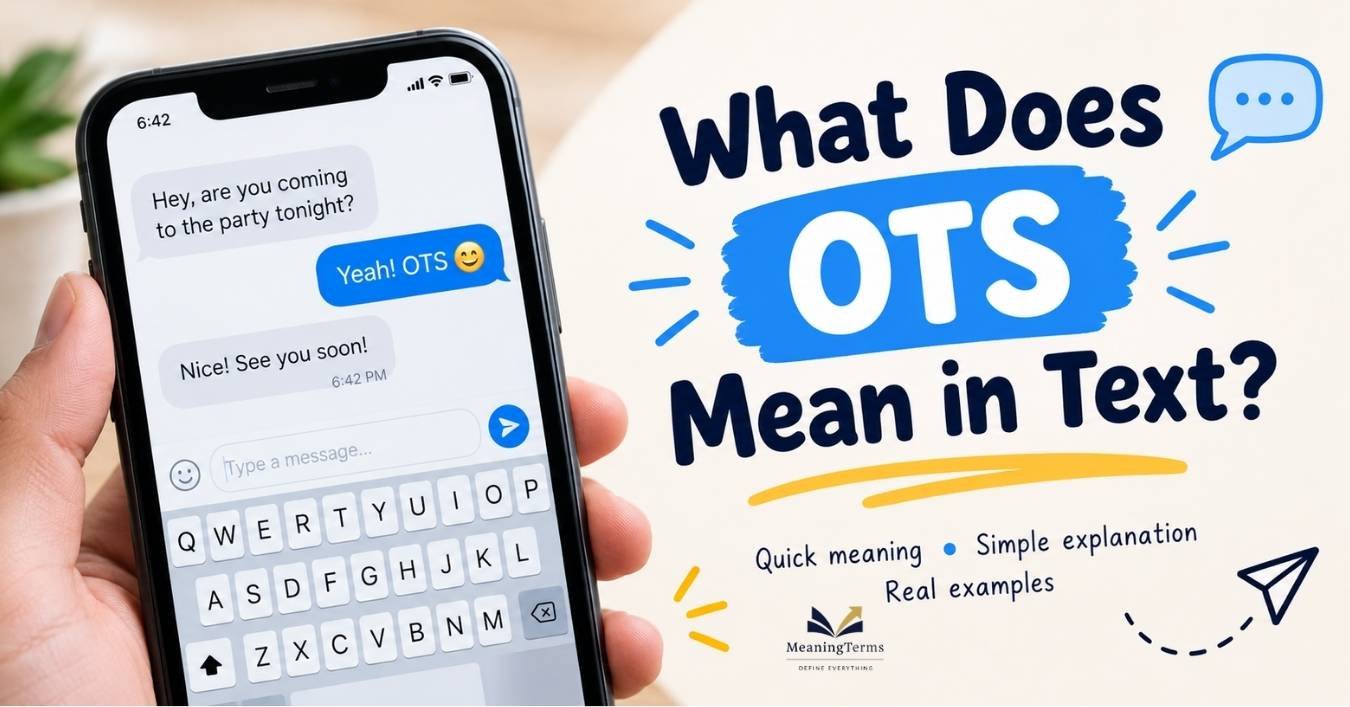
Have you ever received a message saying, “Send me an OTS pic,” and wondered what it meant? You’re not alone. Texting abbreviations can be confusing, especially when friends use unfamiliar internet slang. Three simple letters can leave you guessing about the whole message.
What Does OTS Mean in Text? In casual texting and social media, OTS commonly means “Over The Shoulder.” It usually refers to a photo taken from behind or beside someone, showing their shoulder and the scene in front of them. You might see this term in Snapchat messages, Instagram DMs, or conversations about photography. In this guide, you’ll learn the OTS meaning in texting, see real-life examples, and understand how it differs from terms like POV, BTS, and OOTD.
What Does OTS Mean In Text?
OTS stands for Over The Shoulder. In texting and social media, it commonly describes a photo or shot taken from behind someone’s shoulder. The picture often shows the person and what they’re looking at.
For example, a friend might text, “Send me an OTS pic.” They may want a photo that captures your surroundings without showing a direct selfie.
OTS meaning in text can depend on context. In photography, an over-the-shoulder shot is a familiar camera angle. In casual messages, people may use the same term when requesting a particular photo style.
Quick answer: OTS commonly means “Over The Shoulder” when someone discusses pictures, Snapchat, or Instagram.
Simple Meaning (In Plain Words)
Think of an OTS picture as a photo taken from behind or beside someone. It shows part of their shoulder or back, along with the view ahead.
Imagine you’re sitting at a cafe and looking out a window. Your friend takes a picture from behind you. The photo captures your shoulder, your coffee, and the street outside. That’s an example of an over-the-shoulder photo.
An OTS picture can show different things, including:
- Scenery: Your shoulder appears in the frame while you look at a sunset.
- Outfits: The photo shows your clothes from behind.
- Daily moments: Someone captures you reading, cooking, or using your phone.
- Friends: A picture shows you and the view you’re enjoying together.
OTS can feel more natural than a direct selfie. It captures a moment instead of focusing only on your face.
Where Is OTS Used?
You’ll most likely encounter OTS in casual conversations about photos and social media. People may use it when requesting a picture or describing a particular camera angle.
Here are some places where you might see OTS:
- Snapchat: A friend may ask you to send an OTS pic through chat.
- Instagram: Someone might use OTS in a direct message, caption, or story.
- Text messages: Friends may use the abbreviation when discussing photos.
- Photography: Creators use over-the-shoulder shots to frame a subject and the scene ahead.
- Fashion posts: An OTS picture may show an outfit from behind or at an angle.
For example:
Friend: “Send an OTS from where you’re sitting.”
You: “Sure! I’ll include the view from my seat.”
The meaning becomes clearer when the conversation involves taking or sharing pictures. If OTS appears in another context, check the surrounding message before assuming what it means.
Read More:What Does Hy Mean In Text? (Real Meaning Explained 2026)
Why Do People Use OTS?
People use OTS because it’s shorter than writing “over-the-shoulder picture” every time. The abbreviation also gives a quick idea of the photo style they want.
On social media, photos often tell a story without showing everything directly. An OTS shot can capture a person’s surroundings, outfit, or activity while keeping their face partly out of view.
Here are a few reasons people use OTS:
- Saves time: Three letters are faster to type than the full phrase.
- Describes a photo style: It tells someone which camera angle to try.
- Creates a candid look: The picture can feel natural rather than carefully posed.
- Shows the surroundings: Viewers can see what the person is looking at.
- Adds variety: It offers an alternative to traditional selfies.
For example, “Take an OTS of me watching the sunset” gives a clear photo idea. Your friend knows to capture you from behind while including the sunset.
However, not everyone knows this abbreviation. If the other person seems confused, explain what you mean.
Real-Life Examples Of OTS In Use
Real conversations make the OTS meaning easier to understand. These examples show how someone might use the abbreviation when discussing pictures.
Example 1: A Snapchat request
Friend: “Send me an OTS pic.”
You: “Do you want one with the view in front of me?”
Here, your friend likely wants an over-the-shoulder photo rather than a direct selfie.
Example 2: An Instagram story
You: “Posting an OTS from our beach trip.”
Friend: “The ocean view looks amazing!”
The caption describes a picture that shows part of you and the scenery.
Example 3: An outfit picture
Friend: “Can you take an OTS of my outfit?”
You: “Sure. Stand near the mirror, and I’ll take it from behind.”
The request focuses on the photo angle and clothing.
Example 4: A cafe photo
Friend: “Get an OTS shot of me with my coffee.”
You: “Okay, I’ll include the table and the window view.”
Example 5: An unclear message
Friend: “Can you send OTS?”
You: “Do you mean an over-the-shoulder photo?”
Asking for clarification helps when the message lacks context.
OTS vs Similar Terms (Comparison Table)
Texting slang includes many abbreviations that look similar but have different meanings. Knowing the difference between OTS, POV, BTS, and OOTD can help you understand messages more easily.
| Term | Full Meaning | Common Use |
| OTS | Over The Shoulder | Photo angles and picture requests |
| POV | Point Of View | Videos or content showing a perspective |
| BTS | Behind The Scenes | Making-of content and production moments |
| OOTD | Outfit Of The Day | Fashion photos and outfit posts |
| OTP | One True Pairing | A favorite romantic pairing, often in fandoms |
| OTW | On The Way | Telling someone you’re coming |
| DM | Direct Message | Private messages on social media |
| Selfie | A photo taken by yourself, usually of yourself | Personal pictures |
OTS vs Selfie
A selfie usually focuses on your face. An OTS picture shows part of your shoulder or back along with the scene ahead.
Both styles can show your personality. However, they create different effects.
OTS vs POV
POV means “Point Of View.” It often presents a scene from a particular person’s perspective.
OTS usually shows the person from behind or beside their shoulder. The camera angle makes the two styles different.
OTS vs BTS
BTS means “Behind The Scenes.” It refers to moments showing how something is made or happens.
OTS describes a camera angle or photo style. The terms serve different purposes.
OTS vs OOTD
OOTD means “Outfit Of The Day.” People use it when sharing what they’re wearing.
An OTS photo can show an outfit, but OTS describes the angle rather than the clothing theme.
OTP vs OTS and OTW vs OTS
OTP often means “One True Pairing” in fandom conversations. OTW means “On The Way” in everyday messages.
Neither abbreviation means the same thing as OTS. Always read the full message to understand which term fits.
When Should You Use OTS?
Use OTS when you’re chatting casually with someone who understands the term. It works well when you want to request a specific picture or describe a photo angle.
For example, you might text a friend, “Take an OTS of me looking at the mountains.” This gives them a clear idea of the shot you want.
OTS can be useful when:
- Asking a friend for an over-the-shoulder photo.
- Describing a photo in an Instagram caption.
- Discussing camera angles with a photographer.
- Sharing a candid moment with friends.
- Planning a creative social media post.
Avoid using OTS without explanation when the other person may not know the abbreviation. It’s also better to spell out the phrase in formal writing.
Example conversation:
You: “Can you take an OTS pic for my story?”
Friend: “What kind of picture is that?”
You: “One taken from behind my shoulder, with the view in front of me.”
Clear wording makes communication easier. You can always use the full phrase first and the abbreviation later.
Common Misunderstandings About OTS
OTS can confuse people because the abbreviation may appear in different settings. In photography, it has a clear connection to an over-the-shoulder shot. In casual texting, the intended meaning depends on the message.
Here are some common misunderstandings:
- Thinking OTS always means “On The Spot”: That phrase exists, but it isn’t the main meaning in photo-related texting.
- Confusing OTS with OTP: OTP often means “One True Pairing,” not “Over The Shoulder.”
- Assuming it only describes selfies: An OTS picture can include scenery, outfits, friends, or everyday activities.
- Thinking every OTS picture must show a face: The photo may show only a shoulder, back, or silhouette.
- Assuming everyone knows the term: Some people may never have seen this abbreviation before.
Another mistake is assuming that OTS always refers to a specific social media trend. It can simply describe a camera angle.
If someone sends an unclear message, don’t guess based on the letters alone. Look at the conversation or ask what they mean.
Pro Tips For Using OTS The Right Way
You don’t need to memorize every texting abbreviation. You just need to understand when a term fits the conversation.
If you want to use OTS naturally, keep your message clear and give the other person enough information to understand your request.
Try these tips:
- Add context: Say “OTS pic of the sunset” instead of sending only “OTS.”
- Know your audience: Use the abbreviation with people who understand it.
- Describe the angle: Explain that the photo should show your shoulder and the scene ahead.
- Avoid overusing slang: Too many abbreviations can make a message hard to read.
- Ask when confused: If someone uses OTS in an unfamiliar way, request clarification.
- Respect privacy: Ask permission before taking or sharing someone’s picture.
Here’s a simple example:
You: “Can you take an OTS photo while I look at the city?”
Friend: “Sure. I’ll stand behind you and include the skyline.”
This conversation shows exactly what you want without making the request complicated.
Remember, OTS is useful when it makes your meaning clearer. If it creates confusion, the full phrase works just as well.
Final Thoughts
Now you know the common OTS meaning in text. It usually stands for Over The Shoulder when people discuss photo requests, camera angles, and social media pictures.
If someone says, “Send me an OTS pic,” they likely want a photo taken from behind or beside you. The picture may show your shoulder, your outfit, or the view in front of you.
Keep these points in mind:
- OTS commonly means Over The Shoulder in photo-related conversations.
- You may see it in Snapchat messages, Instagram DMs, and casual texts.
- It differs from abbreviations such as POV, BTS, OOTD, OTP, and OTW.
- The surrounding conversation helps you understand the intended meaning.
You don’t have to feel confused when a new abbreviation appears. Check the context, ask a quick question if needed, and reply naturally.
FAQ Section
What Does OTS Mean In A Text Message?
OTS commonly means “Over The Shoulder” in photo-related texting. It often refers to a picture taken from behind or beside someone, showing part of their shoulder and the scene ahead.
What Does OTS Mean On Snapchat?
On Snapchat, OTS may refer to an over-the-shoulder photo. If someone asks you to send an OTS pic, they may want a picture that includes you and your surroundings.
What Does OTS Mean On Instagram?
On Instagram, OTS can describe an over-the-shoulder photo shared in a post, story, or direct message. The exact meaning depends on the conversation.
What Does OTS Pic Mean?
An OTS pic usually means an over-the-shoulder picture. It captures a person from behind or at an angle, often showing what they’re looking at.
What Does OTS Mean From A Girl?
If a girl asks you for an OTS pic, she may be requesting an over-the-shoulder photo. The abbreviation alone doesn’t reveal her intentions, so consider the conversation before drawing conclusions.
What Does OTS Mean From A Guy?
If a guy says “send an OTS,” he may mean an over-the-shoulder picture. However, context matters, and you can ask him to clarify if the request is unclear.
Is OTS The Same As A Selfie?
No. A selfie usually focuses on the person taking the picture. An OTS photo shows part of a person from behind or beside their shoulder, often including the surrounding scene.
Does OTS Mean On The Spot?
It can stand for “on the spot” in some contexts, but “Over The Shoulder” is the more relevant interpretation in photo-related texting. Check the surrounding words to determine the intended meaning.
How Do You Use OTS In A Sentence?
You can say, “Can you take an OTS photo of me looking at the ocean?” This tells someone you want an over-the-shoulder shot with the view included.
Is OTS A Common Texting Abbreviation?
OTS is recognizable in photography and some social media conversations, but not everyone knows it. If your message might confuse someone, spell out “over the shoulder” instead.

1 thought on “What Does OTS Mean in Text? Here’s the Real Answer (2026)”