

Three small letters. Endless confusion. You spot “BBC” in news alerts, TV guides, and group chats all the time. Yet ask a friend what it stands for, and watch them pause. Here’s the twist. The same letters can mean very different things depending on where you see them. That’s why the BBC Meaning trips up so many people. A newsroom, a football forum, and a text thread each tell a different story.
Here’s the quick answer. BBC stands for British Broadcasting Corporation. It’s the national broadcaster of the United Kingdom. It began as a tiny radio service in 1922. Now it makes news, TV shows, and radio programs. It streams them online too. But email, football, and slang give those letters new twists. Some are harmless. One is best avoided. Ready to crack the code? Let’s get started.
You’ve Seen “BBC” Everywhere. But What Does It Actually Mean?
You open a news app. “BBC” sits in the headline. A friend says, “I heard it on the BBC.” You nod along.
But do you know the BBC meaning? You’re not alone if you don’t. Millions of people search for it every month.
This guide gives you the answer fast. You’ll learn:
- What BBC stands for
- Where it came from
- Why people trust it
- How the same letters mean different things in email, football, food, and more
Some readers saw the letters in a text and felt lost. Others just want the full form. Either way, you’re in the right place. By the end, you’ll spot the right BBC meaning in any headline, chat, or TV guide.
What Does BBC Mean?
BBC stands for British Broadcasting Corporation. That’s the core BBC meaning in plain English. It’s the national public service broadcaster of the United Kingdom. It makes news, TV shows, and radio programs.
Here are the quick facts:
- Full form: British Broadcasting Corporation
- Founded: 1922
- Home base: United Kingdom
- Main funding: The TV license fee
You may also see “BBC” used as crude slang online. That use is explicit and often offensive. It has nothing to do with the broadcaster. Check the context before you reply to a message. If the topic is news or TV, you’re safe.
Simple Meaning (Explained Easy)
Think of the BBC as the UK’s national news and entertainment network. No single company or billionaire owns it. The public pays for it.
Here’s how that works. UK households pay a yearly license fee. The fee rises with inflation each April.
That money pays for programming. So the BBC doesn’t need ads to survive.
Many other networks work differently. They sell ad space or charge subscriptions. The BBC follows a public service model instead. Its goal is to inform, educate, and entertain. The simple BBC meaning is this: a broadcaster funded by the public, for the public.
A Quick History of the BBC
The BBC didn’t start as a TV giant. It began as a small radio broadcaster in 1922. Radio was brand-new technology back then.
Here’s the short timeline:
- 1922: Radio broadcasting starts
- 1927: A Royal Charter creates the British Broadcasting Corporation
- 1932: An early international radio service launches
- 1936: Television broadcasting begins
- 2007: BBC iPlayer arrives and brings online streaming
Over the decades, the BBC grew a lot. It now covers news, documentaries, dramas, comedy, sports, and children’s shows. It reaches audiences on TV, radio, and the internet.
This history explains why the BBC meaning carries so much weight today.
Where Is BBC Used?
You’ll meet the BBC name in many places. Each one has its own job.
- BBC News: Breaking news and world news
- BBC One, Two, Three, Four: The main TV channels
- BBC Radio: Music, talk, and news, including BBC Radio 1
- BBC iPlayer: Live TV and catch-up streaming
- BBC World Service: International radio and news
- BBC Sport: Scores, updates, and match coverage
- BBC Bitesize: Free study help for students
- Documentaries and dramas: Nature series, period dramas, and more
Basically, if it’s UK news, culture, or entertainment, the BBC is probably involved. That’s the wide reach behind the BBC meaning. It’s far more than one news channel.
BBC News Meaning
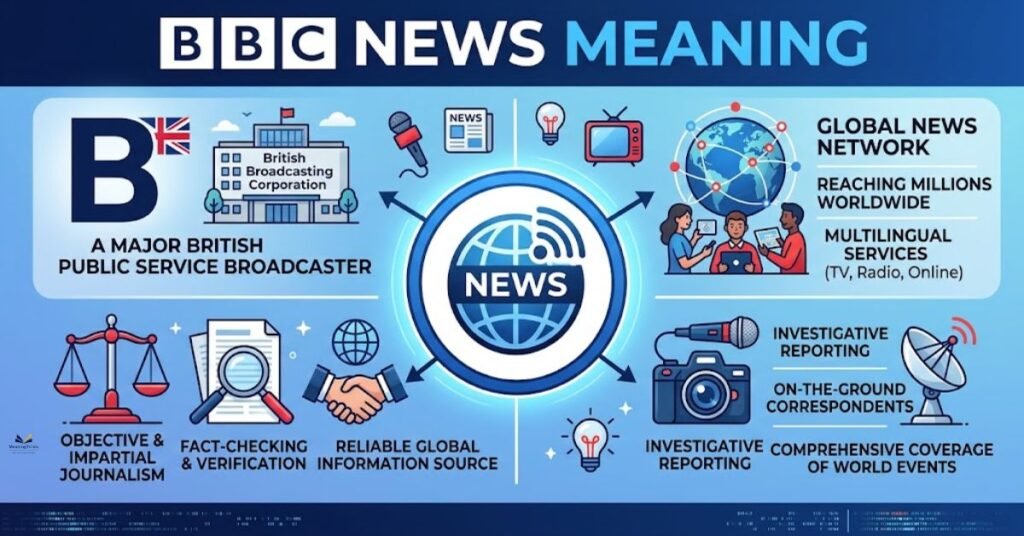
BBC News is the news division of the British Broadcasting Corporation. It reports breaking stories, world events, and UK headlines.
You’ll find it in several forms:
- A TV news channel
- A website and mobile app
- Radio bulletins
- Video clips and live updates
The BBC meaning inside “BBC News” is simple. BBC names the broadcaster. News names the service.
Many people use it for fast updates. It covers politics, business, health, science, and sport. International reporters add global context.
Example:
Mia: Where did you read that story?
Jon: On BBC News this morning.
When you see the phrase, think of a large newsroom with a worldwide reach.
BBC Video
Searching “BBC video” usually means watching clips or shows. You have a few main options:
- BBC iPlayer: Live TV and catch-up shows
- BBC News video: Short news clips and reports
- Documentaries: Nature, science, and history films
The BBC meaning in this case is the broadcaster’s video content. Access can depend on where you live. In the UK, live TV and iPlayer have TV licensing requirements. Some clips are free to view online.
Example:
Leo: Where can I watch that documentary?
Ava: Try BBC iPlayer. Or check the BBC video section.
Availability changes by country. Check the rules for your region before you plan a watch night.
Why Is the BBC So Widely Trusted?
People trust the BBC for several clear reasons.
- Public funding: It doesn’t chase clicks for advertisers.
- Editorial guidelines: Strict rules push reporters toward accuracy and fairness.
- Long track record: It has operated for over a century.
- Global reach: Reporters cover stories in nearly every country.
- Respected documentaries: Its nature and science shows win praise worldwide.
Trust also comes from independence. The BBC works under a Royal Charter. That document helps protect it from direct government control over content.
Of course, no outlet is perfect. The BBC faces criticism like any major news organization. Some people question its bias on certain stories. Still, its long reputation explains why the BBC meaning feels like a mark of quality to millions of viewers.
Read Also: What Does OTS Mean in Text? Here’s the Real Answer (2026)
Real-Life Examples of “BBC” in Use
Here’s how you’ll hear the BBC meaning in daily life.
Checking the News
Friend: Did you see the election results?
You: Yes, I read them on BBC News this morning.
Watching TV
Mom: What are we watching tonight?
Kid: BBC One has a nature documentary.
Streaming a Show
Friend: Have you seen that new period drama?
You: Not yet. It’s on BBC iPlayer, so I’ll watch it tonight.
Traveling Abroad
Traveler: How do you follow world news overseas?
You: I use the BBC World Service app.
See the pattern? In each case, BBC points to the broadcaster. News, TV, radio, and streaming all fit.
BBC Meaning in Email
In email, you’ll rarely see BBC. Most people mean BCC, which stands for blind carbon copy. The two sets of letters look alike. That’s why typos happen.
Here’s the quick breakdown:
- To: Main recipient
- CC: Visible copy
- BCC: Hidden copy
Use BCC to protect addresses in group emails. Nobody sees who else got the message.
Example:
Sam: Why did everyone see my email list?
Lee: You used CC. Try BCC next time.
If an email shows “BBC” in the sender name or subject line, it likely comes from the broadcaster. Check the sender before you click anything. The BBC meaning there is British Broadcasting Corporation.
BBC Meaning in Football
Football fans use BBC for a famous attacking trio. It stands for Bale, Benzema, and Cristiano. They played together at Real Madrid in the 2010s.
The nickname stuck because the three scored so often. Fans still use it in chats and match threads.
Here’s where each meaning fits:
- Fan talk: BBC means the Bale, Benzema, and Cristiano trio.
- Match coverage: BBC Sport reports scores and highlights.
Example:
Fan 1: Remember the BBC at Madrid?
Fan 2: Yes. Nobody could stop them.
So the BBC meaning shifts with context. A football forum points to the trio. A sports headline from the broadcaster points to the corporation.
BBC Meaning Food
Food lovers usually mean BBC Good Food. It’s a recipe website and magazine from the broadcaster’s brand family.
You can browse it for:
- Easy weeknight dinners
- Baking and dessert ideas
- Healthy meal plans
- Step-by-step cooking guides
The recipes use clear steps and common ingredients. Many include ratings and tips.
Example:
Ana: What should we cook tonight?
Ben: Let’s check BBC Good Food.
Ana: Great idea. I’ll find a pasta recipe.
So the BBC meaning in food searches points to recipes, not news. If you spot a “BBC” label on a menu or package, check the context. It may mean something else entirely.
BBC Meaning Medical
There’s no single standard BBC meaning in medicine. Some abbreviation lists show several expansions. They differ by hospital, lab, and country.
That makes guessing risky. A wrong guess could cause confusion.
Here’s what to do:
- Read the full document: Look for a key or glossary.
- Ask the care team: Doctors and nurses can confirm the term.
- Avoid web guesses: Random lists may be wrong.
Example:
Patient: My report says “BBC.” What does it mean?
Nurse: Let me check the chart and explain.
Meanwhile, the BBC also publishes health news. That’s the broadcaster, not a medical term. For any personal health question, talk to a licensed professional.
BBC Meaning Finance
The BBC meaning in finance isn’t fixed. No widely accepted finance term uses those letters on its own. Context is everything.
You may see BBC in these ways:
- Business news: BBC reports on markets and companies.
- BBC Studios: The broadcaster’s commercial arm sells shows worldwide.
- License fee talk: Articles discuss how the BBC is funded.
Example:
Zoe: I saw “BBC” in my bank notes.
Max: Ask the bank. It could be an internal code.
Never act on an unclear abbreviation with your money. Verify it with the company or institution first. This isn’t financial advice. A licensed advisor can help with real decisions.
BBC vs Similar Terms
Other broadcasters have similar-looking names. Here’s how they compare.
| Term | Full Meaning | Type |
| BBC | British Broadcasting Corporation | Public broadcaster, UK |
| CNN | Cable News Network | Commercial news, US |
| ITV | Independent Television | Commercial broadcaster, UK |
| PBS | Public Broadcasting Service | Public broadcaster, US |
| NPR | National Public Radio | Public radio, US |
| CBC | Canadian Broadcasting Corporation | Public broadcaster, Canada |
The big split is funding. CNN and ITV rely on ads and subscriptions. BBC, PBS, NPR, and CBC use public funding models.
So the BBC meaning sits closest to PBS and CBC. All three serve the public first. Shareholders and advertisers come second, if at all.
CNN Meaning
CNN stands for Cable News Network. It’s a US news channel that launched in 1980. Its main job is round-the-clock news.
CNN has one other meaning in tech. There, it stands for convolutional neural network. That’s an AI model used for image recognition.
So context matters here too:
- News chat: Cable News Network
- AI or coding talk: Convolutional neural network
Example:
Dev: I trained a CNN on photos.
Friend: Cool. Not the news channel, right?
Dev: Right. It’s a neural network.
Just like the BBC meaning, the CNN meaning changes with the topic. Read the surrounding words first.
When Should You Rely on BBC as a Source?
The BBC works well in many situations.
Good Uses
- Breaking international news
- High-quality nature and history documentaries
- UK politics and culture updates
- Trusted radio news while you travel
When to Cross-Check With Other Sources
- The topic is complex or political.
- A local outlet may know the region better.
- You’re reading an opinion piece.
Opinion is opinion, even on the BBC. Treat it that way.
Here’s a simple rule. Never use one outlet for a big decision. Compare two or three reliable sources. That habit protects you from blind spots. The BBC meaning stands for quality, but smart readers still double-check.
Common Misunderstandings About BBC
Let’s bust a few myths.
“The BBC Is a Private Company”
Wrong. It’s a public service broadcaster with no shareholders.
“It Only Covers UK News”
Nope. It runs one of the largest international newsrooms.
“The Government Controls It”
Not true. A Royal Charter helps protect its independence.
“BBC Content Is Free Everywhere”
Not quite. In the UK, a license fee funds it. Access abroad varies.
“It’s All Hard News”
Far from it. It also makes comedy, drama, sports, and kids’ shows.
One more mix-up involves slang. Online, “BBC” can mean something crude and unrelated. That’s not the broadcaster. The real BBC meaning in news and TV refers to the British Broadcasting Corporation.
Pro Tips for Using BBC as a News or Entertainment Source
Get more from the BBC with these simple habits.
- Use BBC News for global context: International coverage is a major strength.
- Try iPlayer for UK dramas: It also hosts documentaries and nature series.
- Tune into the World Service: It’s perfect radio news on the go.
- Compare stories across outlets: Big events deserve more than one view.
- Check BBC Sport: Major tournaments get detailed coverage.
- Send students to Bitesize: It offers educational resources for students.
Also, know the rules on access. In the UK, you need a license to watch live TV or use iPlayer. Radio, podcasts, and the BBC website offer free content, although access rules can vary. Smart use starts with knowing the BBC meaning and its limits.
Final Thoughts
The BBC meaning is simple. BBC stands for British Broadcasting Corporation. It’s the UK’s public broadcaster, known worldwide for news, documentaries, and entertainment.
It began in 1922 as radio. It grew into television. Today it streams online too. Through it all, it has maintained a public service model instead of a purely commercial one.
Funding is changing, though. The current Royal Charter ends in 2027. The government is deciding what comes next, so details may shift.
Next time you see those three letters, you’ll know exactly what they mean. Context tells you the rest. Now you can read the news, watch a show, or join the chat with confidence.
Frequently Asked Questions About BBC Meaning
What Does BBC Stand For?
BBC stands for British Broadcasting Corporation. It’s the UK’s public service broadcaster.
Is the BBC Government-Owned?
No. The BBC operates independently under a Royal Charter and receives funding mainly through the TV license fee.
Is BBC Content Free to Watch?
In the UK, a license fee is required to watch live TV and use BBC iPlayer. Outside the UK, access to some shows varies or requires other services.
What’s the Difference Between BBC and CNN?
The BBC is a public broadcaster funded mainly through a license fee. CNN is a commercial network funded through advertising, subscriptions, and other commercial activities.
What Does BBC Mean in Email?
Most people mean BCC, or blind carbon copy. BBC in an email usually refers to the British Broadcasting Corporation or may be a typo.
Does BBC Have Another Meaning Online?
Yes. In slang, it can mean something explicit and offensive. It’s unrelated to the broadcaster, so check the context first.

1 thought on “BBC Meaning: What Does BBC Really Stand For? (2026)”