

Have you ever received an “OFC” message and wondered what it means? You’re not alone. What Does OFC Mean? is a common question among people who use social media and texting apps. OFC stands for “Of Course.” People use it to agree, confirm plans, or reassure someone. For example, your friend might ask, “Can you help me today?” You can simply reply, “OFC!” It’s a quick and friendly way to say yes.
Understanding What Does OFC Mean? also helps you read messages correctly. The OFC meaning in text can change slightly with the situation. Sometimes it sounds warm and supportive. Other times, it may feel sarcastic or impatient. You might see OFC on TikTok, Instagram, WhatsApp, or in everyday chats. In this guide, you’ll learn what OFC means, how people use it, and how to reply naturally. You’ll also discover its different meanings in other contexts.
What Does OFC Mean?
OFC stands for “Of Course.” It’s a common internet abbreviation that makes everyday conversations quicker and easier.
When someone writes OFC, they’re usually agreeing with you or confirming something without hesitation. Think of it as a shorter version of “yes, definitely” or “sure, absolutely.”
For example:
- “Are you coming tonight?” “OFC!”
- “Can I call you later?” “OFC, anytime.”
- “You remember our plan, right?” “OFC, I haven’t forgotten.”
Understanding what does OFC mean becomes easier when you read the entire message. The abbreviation itself expresses agreement, but the surrounding words help you understand the person’s actual intention.
In everyday conversations, OFC slang meaning usually stays close to the original phrase. However, punctuation, emojis, and the relationship between two people can change how the response feels.
Simple Meaning (In Easy Words)
In simple English, OFC meaning is “of course,” “definitely,” or “sure.”
People use it when they want to say yes without typing a complete sentence. It’s especially common when friends are chatting casually or confirming everyday plans.
Consider this example:
- Your friend asks, “Will you save me a seat?”
- You reply, “OFC 😊.”
Your response means, “Of course I’ll save you a seat.” The emoji adds a friendly touch, making the message feel warm rather than abrupt.
The phrase can also provide reassurance. If someone asks, “You’ll still be there for me, right?” replying “OFC” communicates support, although a longer and more personal response might be better for an emotional conversation.
So, if you’re wondering what do ofc mean or ofc what does it mean, remember this simple definition: it usually means “of course,” with the exact feeling depending on context.
Where Is OFC Used?
You can find OFC meaning in texting across several digital platforms. People use it wherever short, informal replies make conversations easier.
Common examples include:
- OFC on TikTok: Agreeing with a comment, supporting a creator, or responding to a question.
- OFC on Instagram: Replying to stories, answering direct messages, or confirming plans.
- OFC in WhatsApp: Chatting with friends, family members, and group chats.
- OFC in gaming chats: Confirming a team strategy or agreeing to join a game.
- OFC in text messages: Giving quick answers without typing the complete phrase.
What Does OFC Mean on TikTok?
On TikTok, OFC usually means “of course.” Users may write it in comments, captions, or private messages to show agreement or enthusiasm.
For example, someone comments, “Are you making another video about this?” The creator might reply, “OFC!”
However, the meaning depends on the content. A comment like “OFC he did that 🙄” might express sarcasm instead of genuine agreement.
OFC Meaning in Chat and WhatsApp
In private chats, OFC often sounds relaxed and familiar. Friends might use it to confirm invitations, accept favors, or reassure one another.
For example:
“Can I borrow your notes?”
“OFC, I’ll send them tonight.”
Here, the sender offers a clear yes. This is a typical example of OFC in text because the abbreviation replaces a familiar spoken phrase.
OFC in Professional Messages
Some people use OFC in informal workplace chats when speaking with familiar colleagues. However, it’s usually better to write “of course” in client emails, official requests, and important business communications.
The full phrase looks clearer and more professional. It also avoids misunderstandings when the recipient isn’t familiar with internet slang.
Why Do People Use OFC?
People use OFC abbreviation because it saves time and keeps casual conversations flowing. Typing three letters feels easier than writing the complete phrase, especially during fast-moving chats.
There are several reasons this expression appears so often in everyday messaging.
- Quick agreement: It communicates an immediate yes.
- Reassurance: It helps someone feel supported or understood.
- Confirming plans: It confirms that an arrangement still stands.
- Friendly texting: It makes ordinary replies feel more conversational.
- Expressing sarcasm: It can highlight something predictable or frustrating.
For example, a friend might ask, “You’ll come to my birthday, right?” A reply like “OFC! Wouldn’t miss it” sounds enthusiastic and reassuring.
However, OFC doesn’t automatically mean someone feels excited. A short reply might simply confirm the information, so avoid reading too much emotion into three letters.
Real-Life Examples Of OFC
The easiest way to understand OFC examples is to see how people use the abbreviation in different situations. The same three letters can communicate agreement, support, or mild sarcasm.
Here are some natural OFC conversation examples.
- Agreeing to help: “Can you explain this question?” “OFC, send it over.”
- Confirming plans: “We’re meeting at six, right?” “OFC, see you there.”
- Showing support: “Can I talk to you about something?” “OFC, I’m listening.”
- Accepting an invitation: “Want to come shopping?” “OFC, let’s go!”
- Responding to a compliment: “You did an amazing job.” “OFC, you helped me a lot!” Here, the reply may sound playful or overly confident, depending on the relationship.
- Expressing sarcasm: “OFC my phone dies when I need directions.” This suggests frustration about an inconvenient situation.
Notice how the sentence changes the meaning. A friendly invitation usually makes OFC sound positive, while an eye-roll emoji can suggest annoyance.
OFC Meaning From A Girl
If a girl texts you “OFC,” she generally means “of course.” She might be agreeing with your suggestion, answering a question, or reassuring you about something.
For example, if you ask, “Do you want to hang out tomorrow?” and she replies, “OFC 😊,” she’s agreeing to the plan. The emoji may add warmth, but it doesn’t prove romantic interest.
Context matters more than the abbreviation. A quick “ofc” could be friendly, neutral, enthusiastic, or sarcastic, depending on your conversation and your existing relationship.
If you’re wondering whether she likes you, look at the broader pattern of communication. Does she initiate conversations, ask questions, and make plans with you? Those behaviors provide more context than one short message.
Read Also: What Does DFK Mean In Text? Real Meaning Revealed 2026
OFC vs Similar Terms
Several common chat abbreviations express agreement, gratitude, or reassurance. However, they don’t all communicate the same thing.
The following comparison explains how OFC differs from other familiar texting terms.
| Term | Full Meaning | Typical Use |
| OFC | Of Course | Agreement or reassurance |
| NP | No Problem | Responding to thanks or an apology |
| FS | For Sure | Strong agreement or confirmation |
| YW | You’re Welcome | Replying to thanks |
| ABSLY | Absolutely | Emphasizing agreement |
| TY | Thank You | Expressing gratitude |
| IDK | I Don’t Know | Showing uncertainty |
OFC vs NP
OFC vs NP comes down to the situation. OFC usually expresses agreement, while NP often means that a request, favor, or apology isn’t a problem.
Example: “Can you send me the picture?” “OFC!” The response agrees to the request. After someone says “Sorry I’m late,” replying “NP” communicates that you’re not bothered.
OFC vs FS
FS meaning in text is generally “for sure.” Both expressions can confirm plans or communicate agreement, but FS often emphasizes certainty.
For example, “Are we meeting tomorrow?” “FS!” confirms the plan. “OFC!” communicates a similar yes, sometimes with a more reassuring or familiar tone.
OFC vs YW
YW meaning in chat is “you’re welcome.” People generally use it after another person says thank you.
For example, “Thanks for helping me!” “YW!” makes sense because the other person is expressing gratitude. OFC wouldn’t serve exactly the same purpose unless the conversation involved agreeing to help.
OFC vs ABSLY
ABSLY meaning is commonly understood as “absolutely” in informal messaging, although spelling and abbreviation habits vary.
Both ABSLY and OFC can express strong agreement. However, ABSLY emphasizes certainty, while OFC often communicates agreement with a sense of expectation or reassurance.
When Should You Use OFC?
Use OFC meaning in text messages when you want to give a quick, natural answer in a casual conversation. It’s particularly useful with friends, relatives, and people who already understand your texting style.
Here are situations where it usually fits:
- Confirming plans with friends.
- Agreeing to help with a small task.
- Responding to a familiar person’s question.
- Reassuring someone during an everyday conversation.
- Joining an informal online discussion.
For instance, your friend might ask whether you’ll join an online game. Replying “OFC, invite me” is direct and easy to understand.
However, choose your words carefully in formal situations. When replying to a customer, teacher, employer, or unfamiliar person, writing “Of course, I’ll take care of it” usually communicates the same message more clearly.
Common Misunderstandings About OFC
Although OFC meaning in chat is straightforward, readers sometimes misunderstand its tone. Short messages leave out facial expressions, vocal emphasis, and other clues that make spoken conversations easier to interpret.
Here are a few mistakes worth avoiding.
Mistake 1: Assuming OFC always sounds friendly. It can express genuine support, but it can also sound impatient or sarcastic.
Mistake 2: Treating OFC as proof of romantic interest. Someone using this abbreviation might simply be answering your question. It doesn’t automatically reveal their feelings.
Mistake 3: Assuming capitalization changes the definition. OFC, ofc, and Ofc usually mean the same thing. Capitalization often reflects personal style or sentence placement.
Mistake 4: Thinking every short reply is rude. Some people naturally prefer brief messages. Their communication habits don’t necessarily indicate disinterest.
Mistake 5: Assuming OFC fits every setting. Informal abbreviations may feel out of place in official documents, job applications, and serious professional emails.
The best way to interpret a message is to read the entire sentence and consider the relationship. If the meaning remains unclear, ask a simple follow-up instead of making assumptions.
Pro Tips For Using OFC The Right Way
Learning how to use OFC is simple, but knowing when it fits makes your messages sound more natural. The goal is to communicate clearly without making every reply feel repetitive.
Follow these practical tips:
- Match the conversation: Use OFC with people who regularly text informally.
- Add context when needed: Write “OFC, I’ll be there at six” instead of sending an unclear one-word reply.
- Use emojis thoughtfully: A smiley can make a friendly response feel warmer, while an eye-roll may signal sarcasm.
- Avoid overusing it: Repeating the same abbreviation in every conversation can make your messages feel less personal.
- Choose professional wording when appropriate: Use complete phrases in formal communication.
Remember that texting abbreviations work best when both people understand them. If someone doesn’t recognize internet slang, writing the complete phrase prevents unnecessary confusion.
Where Did OFC Come From?
The abbreviation OFC comes from the familiar English expression “of course.” People have used the full phrase in spoken and written English for a long time, while digital messaging encouraged shorter forms.
As text messaging, online forums, and social platforms became popular, users adopted internet shorthand expressions to communicate quickly. OFC became one of many abbreviations used in informal digital conversations.
However, the exact date when OFC first appeared isn’t firmly established here. It’s better not to assign the abbreviation a specific inventor or origin year without reliable historical evidence.
Today, OFC is part of everyday online language. Like IDK, NP, and TY, it helps people express familiar ideas with fewer characters.
How To Reply When Someone Uses OFC
Knowing how to reply to OFC depends on what the other person means. You don’t need a special response every time someone uses this abbreviation.
Try these natural replies for different situations:
- When someone agrees to help: “Thank you, I appreciate it!”
- When someone confirms plans: “Perfect, see you tomorrow.”
- When someone reassures you: “That means a lot to me.”
- When someone accepts an invitation: “Great, I’ll send you the details.”
- When someone sounds sarcastic: “Haha, what happened?”
- When someone agrees with your opinion: “Exactly, that’s what I thought too.”
For example, if someone replies “OFC” after you ask for help, a simple thank-you keeps the conversation moving. There’s no need to repeat their abbreviation just to sound familiar.
If you’re unsure about their tone, look at the surrounding messages. A friendly emoji, a longer explanation, or a follow-up question may help you understand their intention.
What Does OFC Mean in Medical and Police Contexts?
Although OFC stands for “Of Course” in everyday texting, its meaning can change in specialized settings. Medical professionals and police departments sometimes use the same letters as abbreviations for different terms.
OFC Full Form In Medical
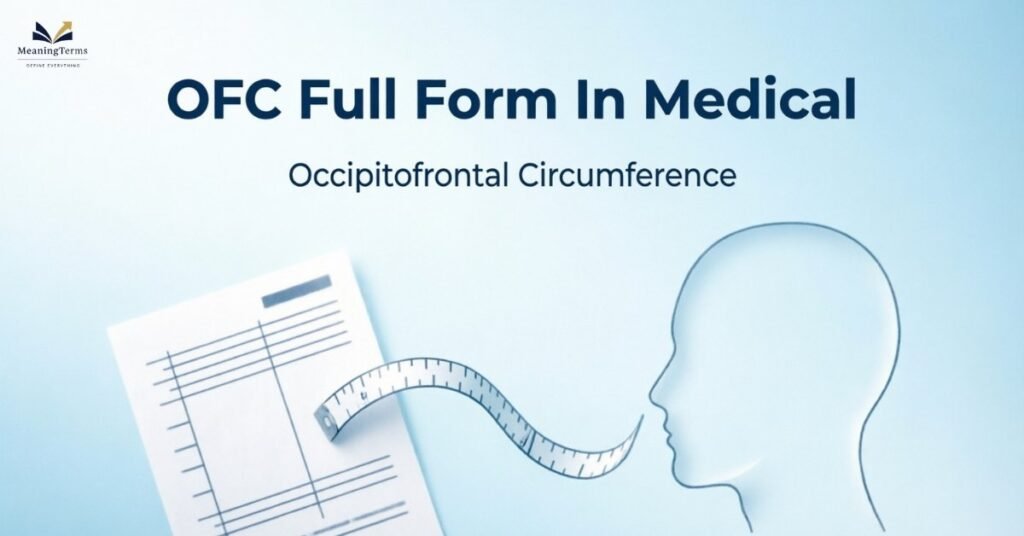
In medical contexts, OFC can refer to occipitofrontal circumference, a measurement of the head’s circumference, particularly relevant when monitoring an infant’s growth.
However, medical abbreviations depend on the document, specialty, and clinical context. Don’t assume this definition applies to every medical report containing OFC.
OFC Appointment Meaning
If you see “OFC appointment” on a booking message or medical document, its meaning depends on the organization using it. The letters might refer to an office, a specific clinic service, or another locally defined term.
Check the appointment confirmation or contact the provider for clarification. Without the surrounding wording, it’s not possible to identify one universal meaning confidently.
OFC Police
In police or law enforcement documents, OFC may refer to an organization-specific role, unit, or administrative term. Its full form isn’t universal across departments and countries.
If you’ve encountered OFC in a police notice, report, or official message, check the department’s terminology or ask the issuing office. The surrounding sentence is essential for interpreting it accurately.
Final Thoughts
So, what does OFC mean? In everyday texting, it usually stands for “Of Course.” People use it to agree, confirm plans, offer reassurance, and keep conversations moving naturally.
You might see OFC meaning in text on TikTok, Instagram, WhatsApp, or in a friend’s private message. Its tone can feel warm, neutral, or sarcastic depending on the situation.
Remember that context matters more than the abbreviation itself. Use OFC when it fits your conversation, choose clearer wording in formal situations, and avoid assuming too much from a short reply.
FAQ’s
What Does OFC Mean In A Text?
OFC means “Of Course” in most casual text messages. It expresses agreement, confirmation, or reassurance.
Is OFC Rude To Use?
No, OFC isn’t usually rude. However, it may sound sarcastic or impatient depending on the conversation and punctuation.
What Does OFC Mean On TikTok?
On TikTok, OFC usually means “Of Course.” People use it in comments, captions, and messages to agree or respond quickly.
What Does OFC Mean From A Girl?
It generally means “Of Course” when a girl sends it. The message alone doesn’t establish whether she’s being friendly or expressing romantic interest.
What Is The Difference Between OFC And NP?
OFC means “Of Course,” while NP means “No Problem.” OFC usually expresses agreement, whereas NP commonly responds to thanks or apologies.
What Does OFC Stand For In Medical Terms?
OFC can mean “occipitofrontal circumference” in medical contexts. Always check the specific document because abbreviations can have different meanings.
Can I Use OFC In Professional Messages?
You can use OFC in some informal workplace chats. For formal emails and client communication, writing “of course” is generally clearer.
