

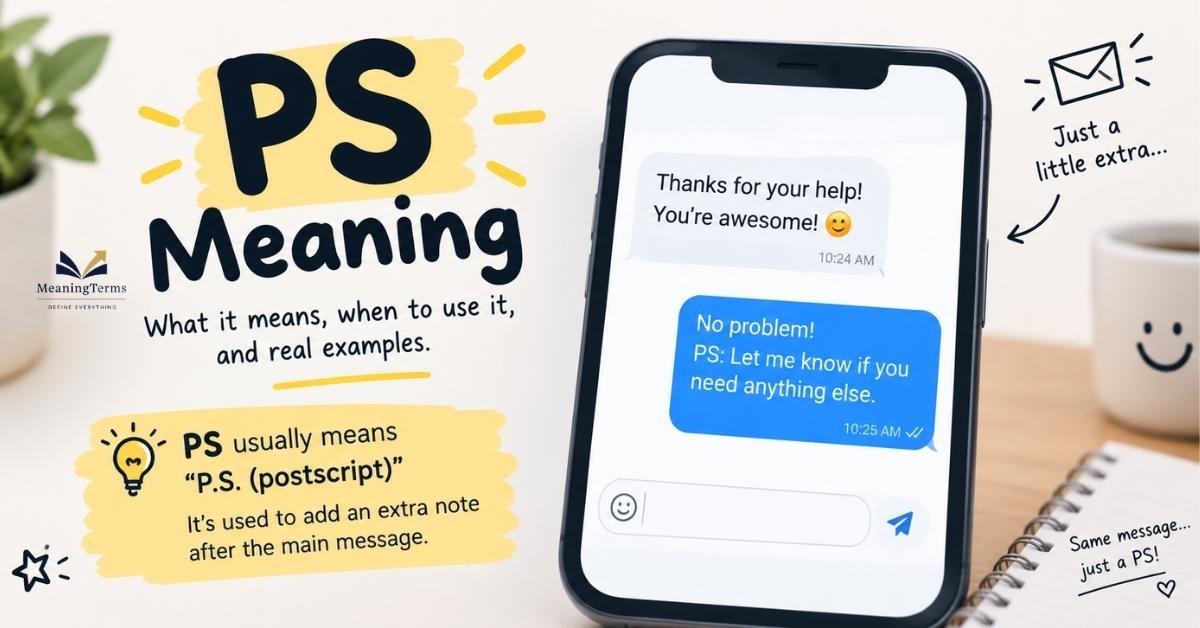
You finish a message and spot “P.S.” at the bottom. Wait, what is that? Is it a joke, a warning, or a secret? Don’t worry. You’re not the only one asking about the PS meaning. Many people see it daily and still wonder. The short answer is easy. PS meaning is “postscript,” a note added after the main message.
Simple, right? But the PS meaning changes with the setting. In a text, it feels playful. In an email, it can push a sale. In a handwritten letter, it adds a warm touch. This guide explains the PS meaning step by step. You’ll learn where it came from and how to use it. You’ll also see real examples and smart replies. You’ll even learn what does PS mean in letters. Ready to understand the PS meaning like a pro? Let’s start.
PS Meaning – Quick Definition
What does PS mean? It’s a tiny label for a personal note you add after the main message.
The P.S. meaning never changes. Only the tone shifts from place to place.
Simple definition
P.S. is the abbreviation for postscript. Think of it as a sticky note at the bottom of your message.
Writers add it for forgotten information, a quick important reminder, or a friendly message.
Quick examples
Here are three postscript examples you can borrow:
- “See you at six. P.S. Bring the charger.”
- “Happy birthday! P.S. Save me a slice.”
- “Thanks for the ride. P.S. You’re a lifesaver.”
Notice how the last line sticks in your head. That’s the whole trick.
Origin & Background of P.S.
The origin of P.S. goes back to the Latin word Postscriptum. It blends “post” (after) and “scriptum” (written).
So Latin word origins hand us a literal phrase: “written after.”
How it started
Picture a person writing a traditional letter format by hand. They finish, sign, and then remember one more thing.
Rewriting the page took hours. So they scribbled a postscript below the signature.
How it evolved
Printing, typewriters, and then email changed modern writing habits. The P.S. abbreviation survived all of it.
Today it works as a style choice. Writers use it to add warmth, humor, or a nudge.
PS Meaning in Letter: What Does PS Mean in Letters?
What does PS mean in letters? It marks a note written after the signature. The writer finished the body but wanted to add one more line.
In letter writing conventions, you place it below your name. Many people still use it in cards, notes, and handwritten correspondence.
Here’s a quick example. “With love, Maya. P.S. Your plant survived!” Now you know what does PS mean in letters and why readers love it.
Real-Life Conversations Using P.S.
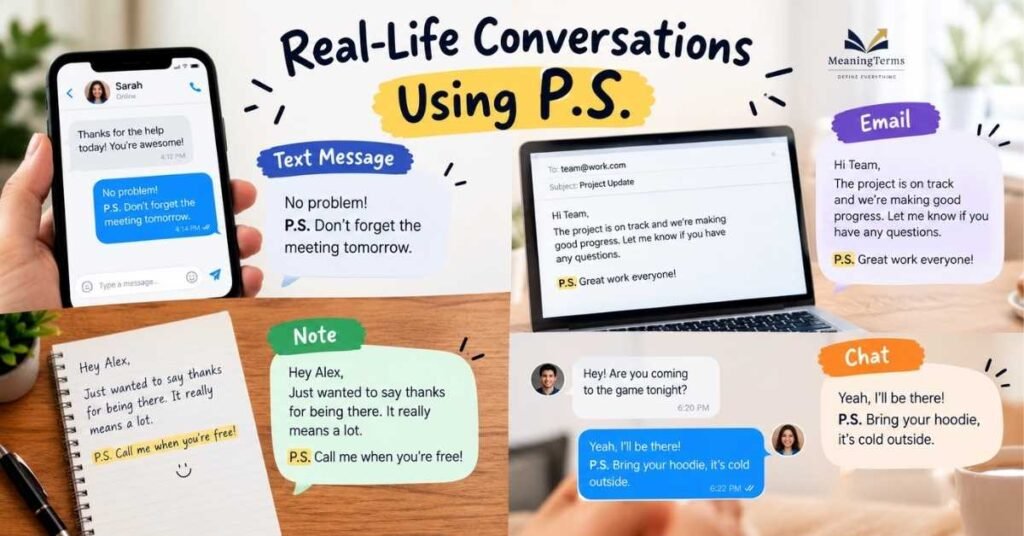
Theory is fine. But real chats show you how P.S. in everyday communication actually sounds.
WhatsApp Conversation
Aisha: I sent the file.
Zain: Got it.
Aisha: P.S. Check the last page first.
That’s P.S. in WhatsApp at its best. Short, useful, and a little bossy.
Instagram DM
Lena: Loved your trip photos!
Ravi: Thanks! 😊
Lena: P.S. That sunset shot is unreal.
This is P.S. in Instagram DMs. It feels like a compliment whispered at the door.
TikTok Comments
User 1: This recipe worked!
User 2: Same here.
User 1: P.S. I doubled the cheese.
Here P.S. in TikTok comments adds a fun detail. It also invites replies.
Text Message Example
Sam: Good luck on your exam!
Joy: Thanks!
Sam: P.S. Sleep tonight. Seriously.
That’s P.S. in text messages. It’s casual, caring, and quick.
Emotional & Psychological Meaning
A P.S. looks small. Yet it carries real emotional expression.
Readers often treat it like a bonus. That’s why it lands so hard.
1. It feels personal
A P.S. sounds like you leaned in and whispered. “P.S. I’m proud of you” hits harder than the same line in the middle.
Affectionate messages feel warmer when you tuck them at the end.
2. It draws attention
Readers remember the last thing they read. So the P.S. grabs reader attention almost by default.
That makes it a memorable message tool. It also explains its use in marketing copywriting.
3. It shows authenticity
A P.S. feels spontaneous, like a thought that just popped up. “P.S. I forgot to say thanks.”
That raw touch builds trust. People believe unpolished lines more.
Usage in Different Contexts
The PS meaning stays fixed. The mood changes with the setting.
Let’s walk through where you’ll meet it most.
Read More: IDM Meaning in Text: What It Really Means Explained 2026
Social Media
Creators use P.S. in social media captions for playful extras. “New vlog is live. P.S. Watch the ending.”
It boosts social media engagement because it teases the next move.
Friends & Relationships
Friends use it for jokes and casual communication. “See you tonight. P.S. Bring snacks.”
Couples use it for sweetness. “Miss you. P.S. Call me later.”
Work or Professional Emails
P.S. in professional emails works best for quick reminders. “Thanks for joining. P.S. Please send reports by Friday.”
Keep it short and useful. That fits solid email etiquette.
Casual vs Serious Tone
Match the conversational tone to the audience. A friend gets a joke. A client gets a clear reminder.
When in doubt, choose the calmer option. You can always warm up later.
PS Meaning in Email: Why It Still Works
P.S. in emails remains popular because inboxes are crowded. Readers skim and then land on that last line.
For promotional emails, it’s a prime spot for a marketing call to action. Writers use it to push customer engagement.
For effective email writing, keep your P.S. under two sentences. Make it extra information that adds value, not noise.
Common Misunderstandings
Plenty of people trip over the same ideas. Let’s clear them up.
1. Thinking it only belongs in letters
Old habits die hard. But P.S. in modern communication thrives online.
You’ll find it in digital communication, captions, and comments.
2. Assuming it means something secret
Some readers think a P.S. hides a code. Usually it’s just an additional thought.
Yes, a secret P.S. exists as a joke. It isn’t the default.
3. Using too many postscripts
“P.S., P.P.S., P.P.P.S.” can feel messy. One extra note usually does the job.
Too many tags dilute emphasis in writing.
4. Using it in extremely formal documents
Official documents, legal contracts, and academic writing rarely include a P.S. Those formats value clean structure.
Save it for formal and informal writing that allows personality.
Comparison Table
Many messaging abbreviations overlap. This table shows how they differ.
| Term | Meaning | Best Use |
| P.S. | Postscript, extra note after the message | Emails, texts, letters |
| P.P.S. | Second postscript | Rare, often playful |
| BTW | By the way | Casual chat |
| FYI | For your information | Work updates |
| Note | Added detail | Neutral writing |
Key Insight
P.S. versus BTW comes down to timing. BTW sits inside a thought. P.S. waits at the end.
P.S. versus FYI is about tone. FYI sounds official. P.S. sounds human.
Variations and Types of P.S.
Writers have built a whole toolkit around this tiny tag. Here are ten P.S. examples worth knowing.
1. P.P.S.
P.P.S. meaning is “post-postscript.” You add it after your first P.S.
Use it when a second thought sneaks in. “P.P.S. Bring an umbrella.”
2. P.P.P.S.
P.P.P.S. meaning is a third extra note. People use it mostly for laughs.
“P.P.P.S. I swear this is the last one.”
3. Marketing P.S.
A marketing P.S. repeats the offer. “P.S. The discount ends tonight.”
Marketers trust it because readers often scan the end first.
4. Emotional P.S.
This one carries feeling. “P.S. I miss you.”
It works because it sounds unplanned.
5. Reminder P.S.
A reminder P.S. offers a gentle nudge. “P.S. Don’t forget tomorrow’s meeting.”
It’s polite and clear.
6. Funny P.S.
Funny P.S. examples break tension. “P.S. I ate your cookies.”
Keep the joke short. Long jokes lose the charm.
7. Storytelling P.S.
A storytelling P.S. adds a tiny scene. “P.S. The cat knocked over the cake.”
It leaves readers smiling and curious.
8. Romantic P.S.
Romantic P.S. messages shine in love notes. “P.S. You’re my favorite person.”
Romantic notes like this feel sincere because they close the message.
9. Social Media P.S.
Creators drop these into captions. “P.S. Watch until the end.”
It boosts retention and comments.
10. Secret P.S.
A secret P.S. teases a hidden line. “P.S. You didn’t hear this from me.”
It’s playful. Nobody actually expects secrets.
How to Respond When Someone Uses P.S.
A good reply matches the sender’s tone. You don’t need a script. You just need to acknowledge the note.
Here’s how to answer how to respond to P.S. in four moods.
Casual Replies
- “Got it!”
- “Noted.”
- “Won’t forget.”
Funny Replies
- “Too late, I ate the snacks.”
- “That P.S. was the best part.”
- “Okay, now I’m curious.”
Mature or Confident Replies
- “Thanks for the reminder.”
- “I appreciate the extra note.”
- “Good point. I’ll handle it.”
Respectful or Private Replies
- “Thank you for sharing that.”
- “I’ll keep that in mind.”
- “That means a lot.”
PS Meaning in Social Media and Chat
PS meaning in chat matches the email version. It’s an afterthought tacked on to a quick message.
On social media language feeds, it adds spice to Instagram captions and TikTok comments. It also signals that more info is coming.
If you’re asking what does P.S. mean in texting, the answer is the same. It’s a late addition to online conversations.
How to Use P.S. (and When to Use P.S.)
Learning how to use P.S. takes about a minute. Finish your main message, add a new line, type “P.S.,” then write your note.
Think about when to use P.S. carefully. Use it for one friendly reminder, one joke, or one heartfelt line.
Skip it when the information is essential. If your reader must know it, put it in the body.
Regional & Cultural Usage
The PS meaning works worldwide. How often people use it depends on regional communication styles.
Let’s check the major patterns.
Western Culture
In the US and Europe, people use P.S. in emails, marketing, and casual notes. Brands rely on it to capture attention.
It feels normal and welcome there.
Asian Culture
Many Asian communication styles favor structure. People understand P.S., yet they use it more in casual chats than formal ones.
Friendly messages between peers are the most common home for it.
Middle Eastern Culture
Warm greetings matter in many Middle Eastern conversations. A P.S. can add a thoughtful touch.
“P.S. Please give my regards to your family.”
Global Internet Culture
On the web, P.S. travels freely across internet slang, blogs, and comment sections. Nobody owns it anymore.
That shared habit shapes global internet culture.
Frequently Asked Questions
What does P.S. mean in texting?
P.S. stands for postscript. It’s an extra note after the main message that you add as a last thought.
Is P.S. formal or informal?
It can be both. Emails treat it as semi formal while texts treat it as casual.
Why do people use P.S.?
People use it to add forgotten details or stress an important reminder. It also makes a message feel more personal.
What does P.P.S. mean?
P.P.S. means post-postscript. You add it after your first P.S. for a second extra thought.
Can P.S. appear in social media captions?
Yes. Creators use P.S. in social media captions for humor, teasers, and extra context. It also nudges people to comment.
Conclusion
The PS meaning is easy to remember. P.S. stands for postscript, a short note added after the main message. It began in handwritten letters and now lives in texts, emails, and captions. You also know what does PS mean in letters: a line written below the signature.
Now it’s your turn. Try a P.S. in your next message and see how it lands. Then tell us in the comments which line worked best. Share this guide with a friend who still asks about the PS meaning.
